
There is a distinct, almost tectonic shift that occurs exactly thirty days before your wedding.
Up until this point, the planning process has been an exercise in architecture. You have built a grand stage out of floral concepts, lighting grids, catering menus, and guest-list mathematics. But as the calendar slips into the final four weeks, the logistical gears begin to spin faster. The email threads multiply. The phone calls become urgent. Your phone rings with family members suddenly debating dress codes, and your planner is asking for the final seating layout.
It is during this high-velocity countdown that many couples make a silent, unintended trade: they sacrifice their emotional peace to feed the logistical beast.
But Inawo believes in a different path. The final thirty days should not be a panicked sprint to a finish line; they should be a slow, conscious approach to a sacred threshold. This month is not about perfecting the production—it is about preparing your hearts for the reality of the vows.

@manowsmith
The Psychological Shift: From Director to Spouse
For the past six to twelve months, you and your partner have essentially acted as executive producers of a highly complex live event. You have made hundreds of micro-decisions, managed budgets, and coordinated a massive team of creative partners.
The danger is that "Producer Mode" is incredibly addictive. The brain loves the dopamine hit of crossing items off a checklist. But you cannot walk down the aisle as a producer. If you do, you will spend your ceremony analyzing the acoustics of the room, checking the alignment of the tables, and mentally timing the program instead of feeling the visceral magic of the moment.
Transitioning from "the person directing the show" to "the person living the marriage" requires a conscious identity shift.
Around the 30-day mark, you must begin to intentionally dismantle your producer mindset. You have to start looking at your wedding day not as a performance to be executed flawlessly, but as a living, breathing experience to be felt. To do this, you must build what we call the "Absolute Boundary."
The 14-Day Line in the Sand
Psychologists who study decision fatigue note that the human brain has a finite capacity for high-stakes choices. When that capacity is breached, anxiety spikes, and emotional connection drops.
To prevent this, the modern couple must draw a strict, non-negotiable boundary exactly fourteen days before the ceremony. This is your logistical handover.
On day 14, your active planning role ends. All remaining guest-list adjustments, seating arrangements, vendor payments, and timeline tweaks are handed entirely over to your planning team or a trusted family representative.
"We told our planner, 'As of two weeks out, you are the CEO of this wedding. Do not email us with problems unless the venue is literally on fire.' It felt terrifying at first, but those two weeks of silence allowed us to actually look each other in the eye and remember why we were getting married."
— Anjola, an Inawo Groom
Yes, there will be minor details left unfinished. Yes, a guest might cancel at the last minute. Yes, the napkin color might be a shade off. But at fourteen days out, you must decide that the peace of your partnership is more valuable than a perfect detail.
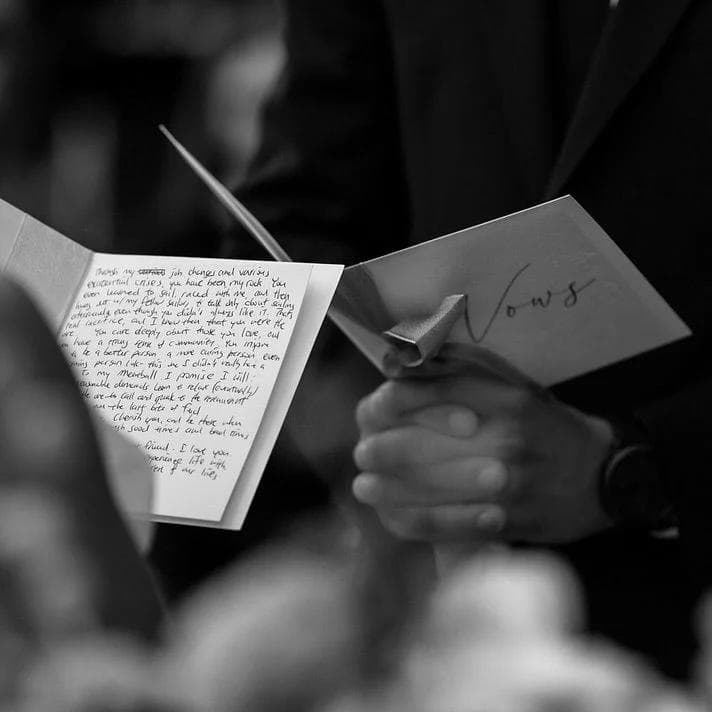
photo from pinterest
The Legacy Ritual: Letters to the Threshold
In the final week of the countdown, the noise can reach a crescendo. To ground yourselves in the weight of the moment, we suggest a simple, beautiful editorial ritual: Writing your Letters to the Threshold.
Find a quiet morning or evening during the last seven days. Sit in separate rooms with a piece of high-quality paper and a pen. Write a letter to your partner, but do not write about the wedding day itself. Instead, capture the raw, honest feelings of standing on this specific threshold.
- What to write: Describe who you are in this very moment. Write about your hopes for your first year of marriage, the specific qualities in your partner that make you feel safe, and the promises you are making to them in the quiet spaces of your heart.
- The Ritual: Fold the letters, seal them in heavy envelopes, and exchange them on the night before the wedding. But do not open them.
- The Legacy: Place these sealed envelopes in a secure box and promise to open and read them together on your first wedding anniversary.
When you open them one year later, the champagne bubbles will have faded, but these letters will serve as a time capsule, instantly transporting you back to the exact, sacred heartbeat of the night before you became husband and wife.
Pockets of Sanctuary: The Digital Sabbatical
In the final 30 days, your phone becomes a source of ambient stress. Your notifications are a constant stream of RSVP updates, registry alerts, and family group chats chiming in with opinions.
To keep your connection pure, institute the "Sunset Sabbatical" during the final month.
Every evening at 8:00 PM, both of you place your phones in a basket by the front door. For the rest of the night, you are unreachable to the wedding production. This ensures that your last conversations before sleep are about your days, your dreams, and your connection—not about whethe

photography: @omiliavisuals
The View from the Altar
When you finally stand at the altar, looking into the eyes of the person you have chosen for a lifetime, the seating chart won't matter. The flower walls will fade into the background. The music will become a soft murmur.
The only thing that will exist in that space is the two of you, the promises you are making, and the love that brought you there.
Do not arrive at that moment exhausted, hollowed out by months of logistics, and emotionally distant from the person holding your hand. Protect your peace. Protect your connection. Walk into the 30-day horizon with your eyes up, your shoulders down, and your hearts entirely open to the beautiful life you are about to build together.
NEXT READ

The "No-Wedding-Talk" Date Night



Plan Your Dream Wedding with Ease
Give your wedding the unique experience it deserves